Business requirements and capacity
Service targets, workload, peaks, reserve and failure scenarios
Home / Training / Capacity management
New · ISO/IEC 20000-1 · ISO/IEC 27001 Annex A · BSI OPS.1.1.1, OPS.1.1.5 and DER.1
All values are green. The business still cannot work. The course shows how to derive capacity from the business, measure correctly, detect bottlenecks, alert in a way that enables action, plan logging by purpose and justify measures with data. For system, network, database and cloud administration, monitoring owners, operations control and platform teams as well as IT operations management, service owners and those responsible for resource planning and IT budget.
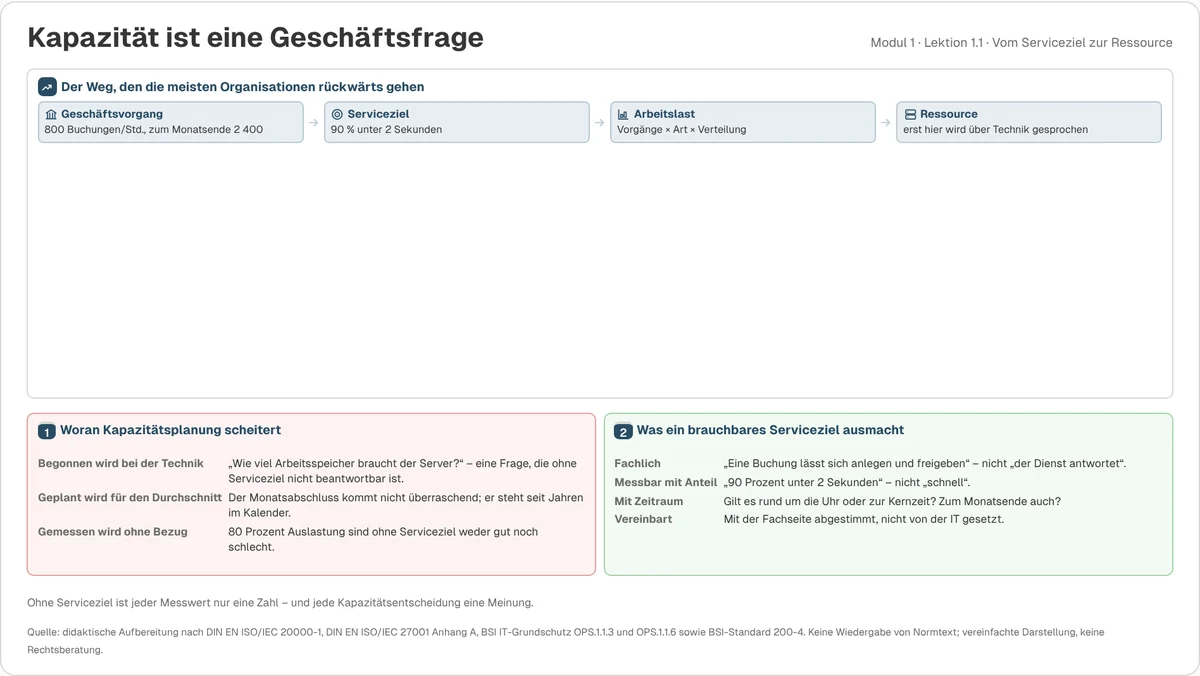
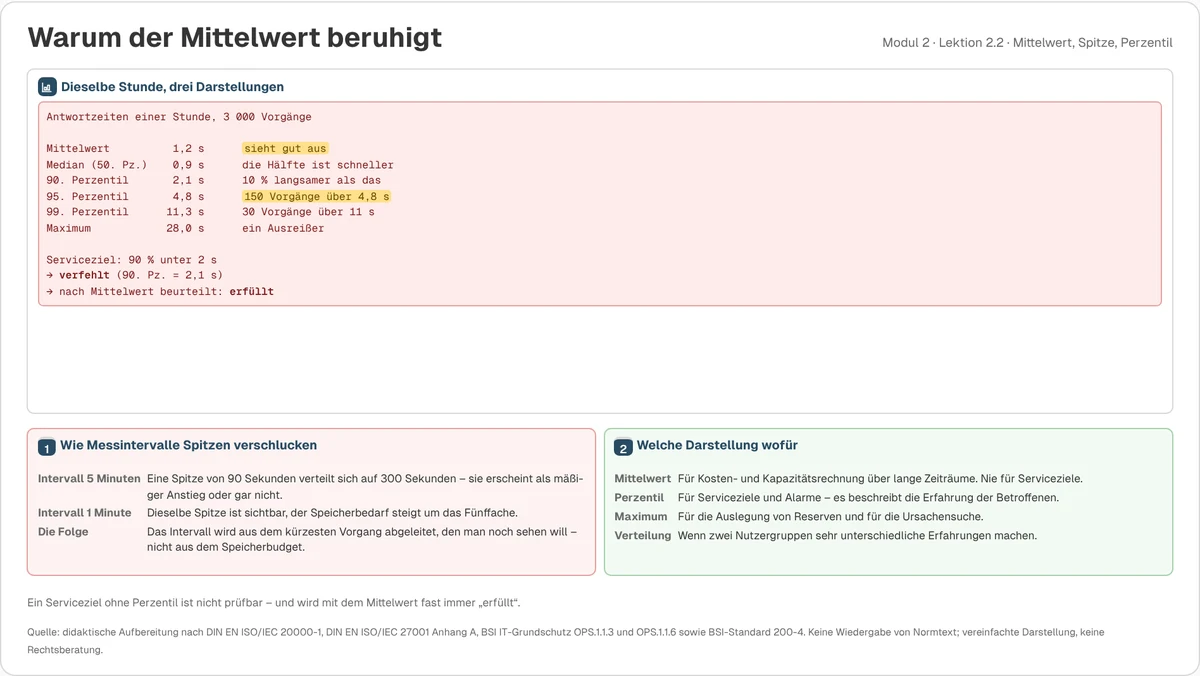
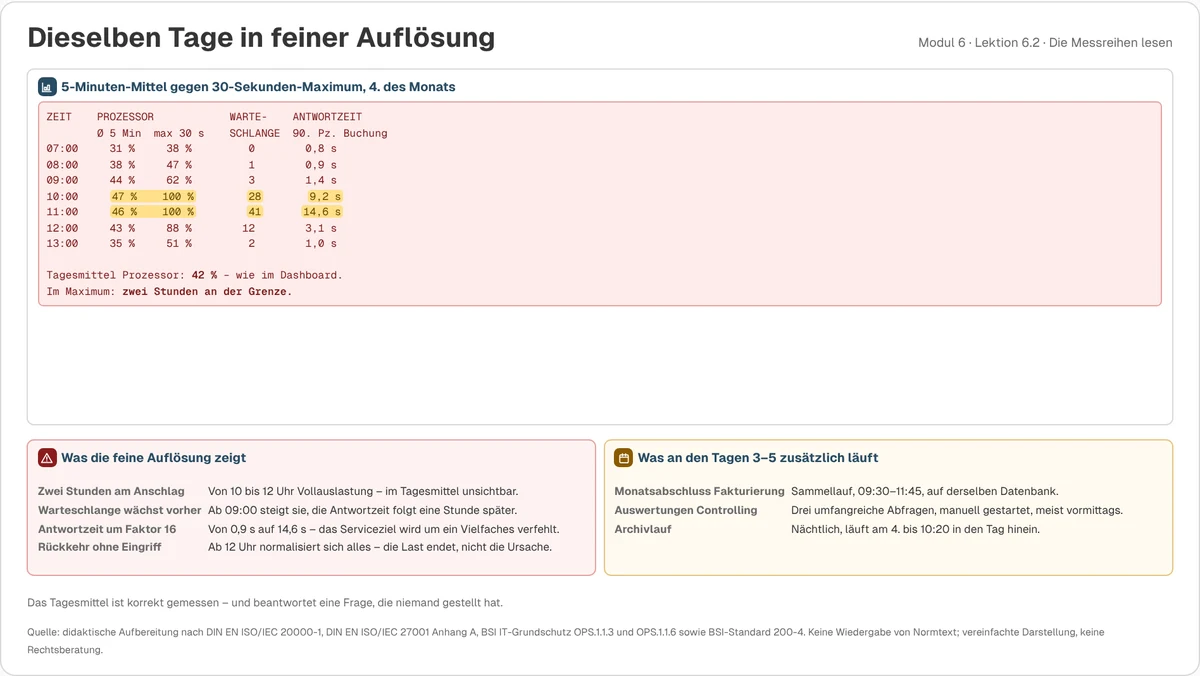
Unremarkable values despite noticeable degradation are the rule: a daily average of 42 percent is compatible with two hours at full load, an availability of 99.9 percent with a service nobody can use. What is easy to measure gets measured – CPU, memory, disk space – not the response time of the business transaction. Alerts come too late, and logs that are only read when something breaks are an archive.
The course counters this with service targets that state a share and a period, percentiles instead of averages, queues as an early indicator, measuring points at every transition, transaction checks, alerts with a duration condition, a named role and a first step, logging planned by purpose and a forecast with stated assumptions. It deliberately does not give universal thresholds, measurement intervals or retention periods.
Service targets, workload, peaks, reserve and failure scenarios
Utilisation, throughput, response time, queues; average, peak and percentile; bottleneck and trend
Measuring points and intervals, component and transaction checks, dashboards, monitoring the monitoring
Thresholds and duration conditions, alert floods and correlations, responsibility and escalation
Purpose and choice of events, time reference and central collection, access, retention and storage requirements
One case over six lessons: measurement series, logs, bottleneck, gaps, options, decision paper
Enforceable service commitments, own measurement instead of the provider’s report, report review and evidence file
Capacity plan, metrics, effectiveness review and transfer
Capacity in practice: how attacks become visible in logs is covered in depth in SIEM use cases; how capacity changes are implemented safely is shown in Change management. You manage service providers’ performance commitments with Outsourcing management.

Auditor’s view
“More measurement data does not automatically mean better control – and a silent sensor looks like silent operations.”
Heinrich Markus Schulte · IT auditor and expert witness
Brochure as PDF (4 pages, 621 KB)
How to book: Individually without a subscription: €399 net per person, 12 months’ access. As an add-on to the subscription at the same price per person. Complements the courses on SIEM use cases, change management and outsourcing management.
Live Add live: Consultation hour 60 min. for your questions, €290 · Workshop 3 hrs, e.g. defining service targets, metrics and alerting rules for your critical services, €890
Request a live sessionCompany-wide licence, white label and operation on your own web space on request; test access and demo on request. Basis: DIN EN ISO/IEC 20000-1 (capacity management; monitoring, measurement, analysis and evaluation), DIN EN ISO/IEC 27001 (Annex A: capacity management, logging, monitoring activities, clock synchronisation) and BSI IT-Grundschutz modules OPS.1.1.1, OPS.1.1.5 and DER.1; security monitoring is only covered as an interface; standard texts are not reproduced. Universal thresholds, measurement intervals and retention periods are deliberately not taught; your organisation’s service targets and requirements are authoritative. Legal status November 2026. The certificate confirms attendance; it is not a certification or audit opinion. No legal advice. “BSI” is a mark of the BSI.
Related
Single seat, annual subscription or training package
Together we put together a training package that fits your responsibilities and your qualification needs. All courses run on the Vercora training portal, with knowledge checks and a certificate of attendance that can be verified online.