Basics and classification
Disruption, emergency, crisis; the special organisational structure; the order of priority “people first”
Home / Training / Crisis team induction
New · BSI Standard 200-4 · FwDV 100 (S1 to S6) · DIN SPEC 14027 · Section 32 BSIG · Art. 19 DORA · Art. 33 GDPR
Appointing is quick. Inducting is something else. Crisis teams are appointed and rarely inducted – which only becomes apparent in a crisis: when someone asks who may decide up to what limit, people look it up, and while they look it up, the reporting deadline is running. The induction covers classification, role and deputies, decision authority, alerting, situation picture and log, the command cycle, reporting deadlines and crisis communication – and running a crisis in the Vercora control centre. For members of the crisis team and core team, their deputies, staff assistants and functions S1 to S6, as well as emergency managers, IT operations and security officers, communications and HR.
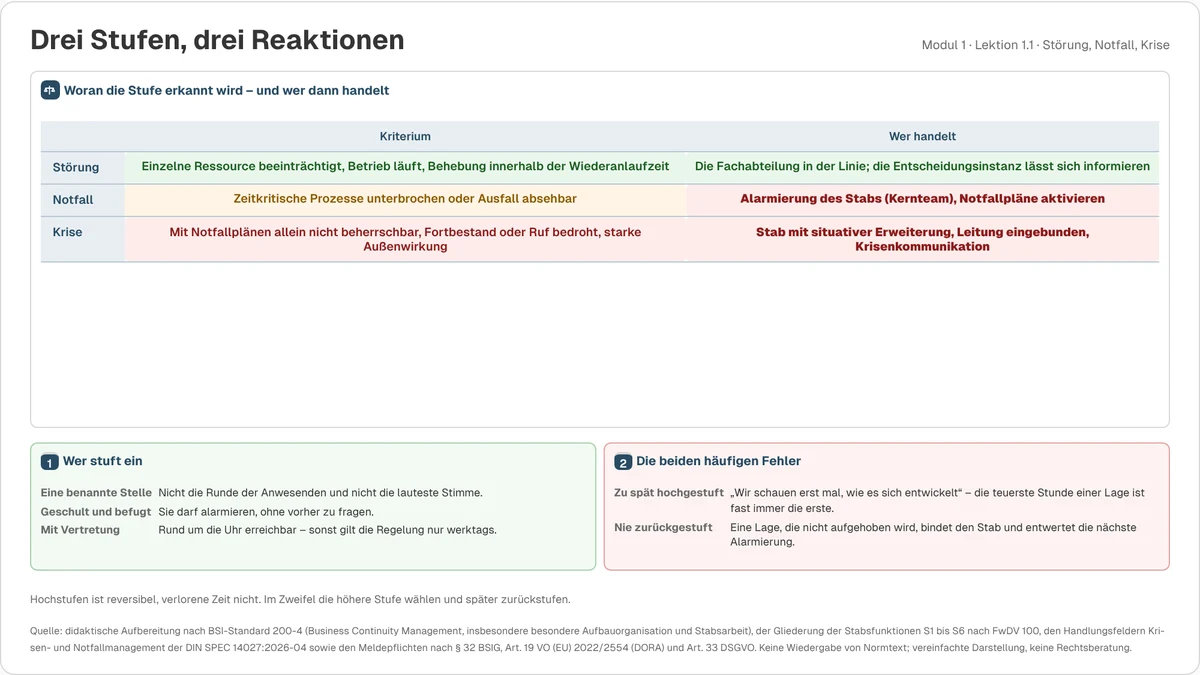
Classification is postponed, and as long as nobody says whether it is a disruption, an emergency or a crisis, the line organisation keeps working on an event it is not set up for. Roles are confused with people: everyone waits for “the person in charge” instead of the staffed function, and the deputy does not dare to decide. Reporting deadlines under Section 32 BSIG, Art. 19 DORA and Art. 33 GDPR start with awareness, not with the team being staffed – and decisions are made in conversation and documented afterwards.
The induction counters this with three levels with verifiable criteria, a role card per function with deputy and interfaces, a decision framework with amount, scope and escalation threshold, an alerting chain with acknowledgement, situation picture and log as ongoing work, a command cycle based on FOR-DEC, reporting deadlines with a named observer and a short exercise that tests your own role.
Disruption, emergency, crisis; the special organisational structure; the order of priority “people first”
Function instead of person, deputies and interfaces, decision framework and escalation threshold
Alerting chain with acknowledgement, availability – and the first 60 minutes step by step
Situation picture and log, command cycle based on FOR-DEC, tasks, emergency changes, handover
Reporting obligations and deadlines under Section 32 BSIG, Art. 19 DORA and Art. 33 GDPR; crisis communication
Crisis room and wall display, crisis manual – and working when your own resources fail
Eleven lessons: create a crisis, alert and acknowledge, situation picture and deadline traffic light, FOR-DEC, task board, recovery
An exercise inject with four questions on your own function, standing down the crisis and follow-up from the log
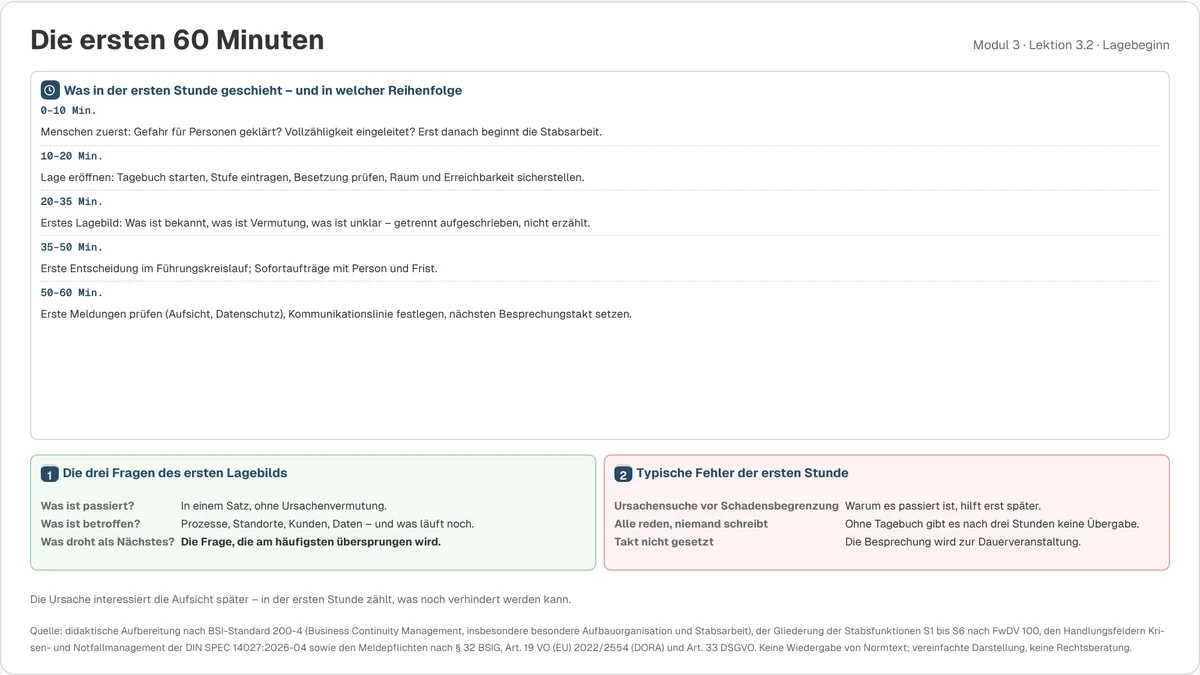
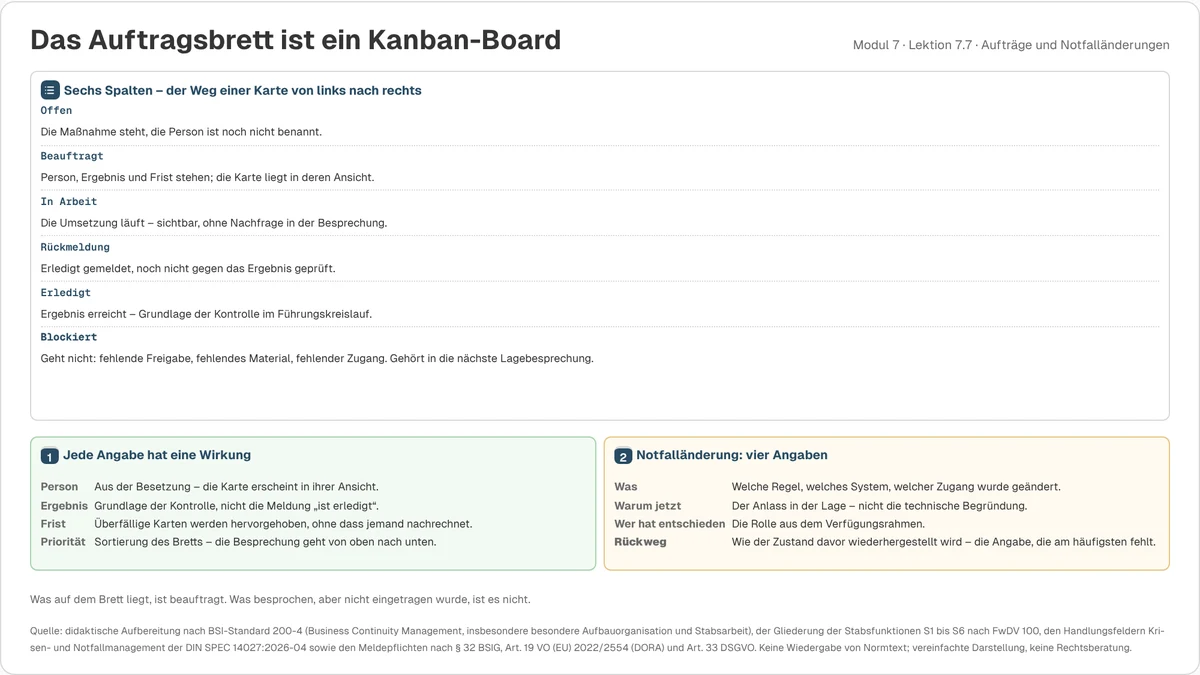
Crisis team in practice: the emergency and crisis control centre in Vercora covers alerting with acknowledgement, situation picture, deadline traffic light and task board. The preparation behind the crisis is taught in Emergency Management and BCM; the annual exercise for management in the NIS2 tabletop exercise.

Auditor’s view
“In a crisis you don’t look up who may decide. Either it has been settled beforehand – or no decision is made.”
Heinrich Markus Schulte · IT auditor and expert witness
Brochure as PDF (4 pages, 665 KB)
How to book: Individually without a subscription: €299 net per person, 12 months’ access. Included in the NIS-2 package Complements emergency management and BCM, the NIS2 tabletop exercise and incident response.
Live Add live: Consultation hour 60 min. for your questions, €290 · Workshop 3 hrs, e.g. defining role cards, decision framework and alerting chain for your crisis team, €890
Request a live sessionCompany-wide licence, white label and operation on your own web space on request; test access and demo on request. Basis: special organisational structure and crisis team work under BSI Standard 200-4, staff functions S1 to S6 under FwDV 100, the fields of action crisis and emergency management under DIN SPEC 14027:2026-04 and the reporting obligations under Section 32 BSIG, Art. 19 Regulation (EU) 2022/2554 (DORA) and Art. 33 GDPR; standard texts are not reproduced. Whether and within which deadlines your company must report depends on its classification and is not determined by the course. The induction replaces neither the signed induction record nor the crisis team exercise; the control centre screenshots are redrawn. Legal status November 2026. The certificate confirms attendance; it is not a certification or audit opinion. No legal advice. “BSI” is a mark of the BSI.
Related
Single seat, annual subscription or training package
Together we put together a training package that fits your responsibilities and your qualification needs. All courses run on the Vercora training portal, with knowledge checks and a certificate of attendance that can be verified online.